Coaching vs. Mentoring: Unlock the Essential Difference That Will Define Your Tech Career Path
In the fast-paced tech world, the wrong guidance can stall your growth. Discover the critical differences between coaching and mentoring, and learn how to choose the right support to transform your career—from mastering technical skills to navigating long-term leadership.
Published on December 17, 2025
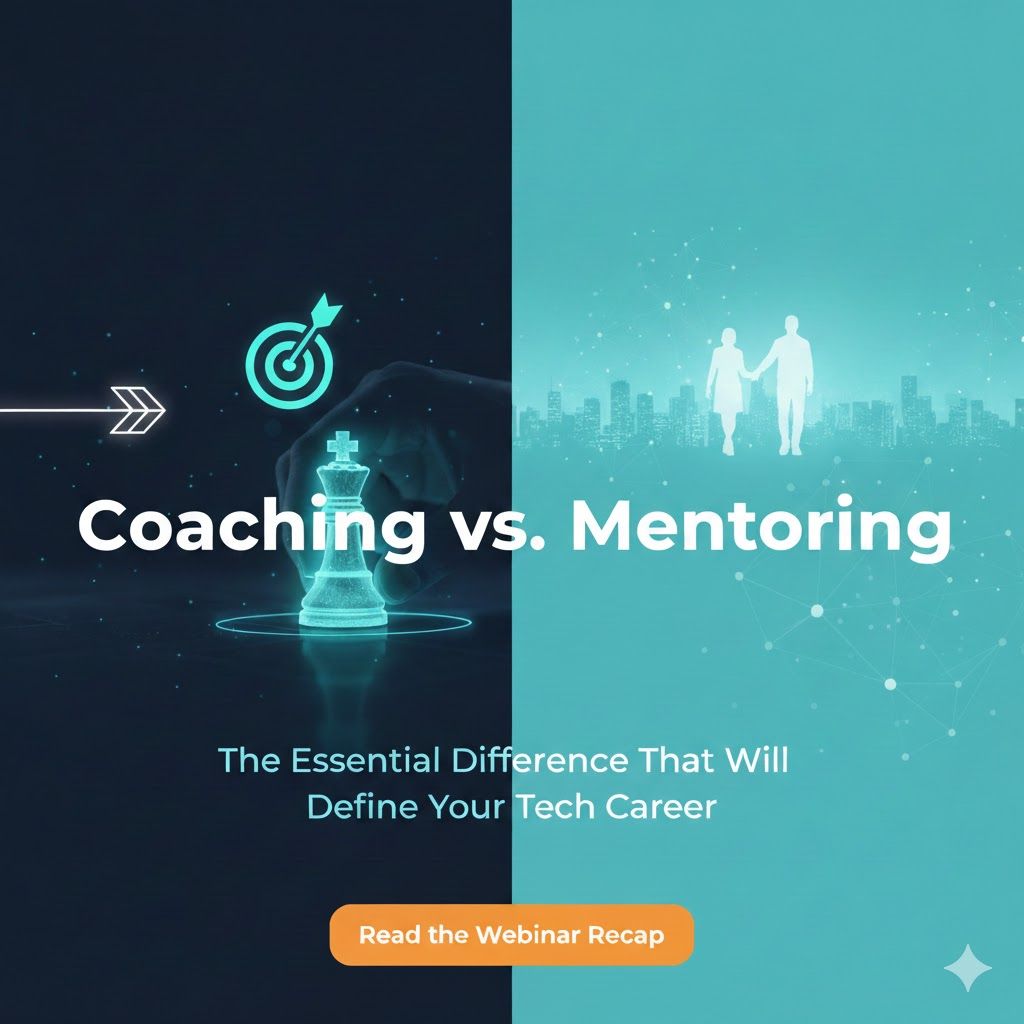
In the fast-paced world of technology, career trajectories are rarely linear. They twist, turn, and demand constant adaptation. To navigate this landscape effectively, professionals rely on guidance, but often use the terms "coaching" and "mentoring" interchangeably. This common confusion can lead to mismatched expectations and missed opportunities. Understanding the fundamental difference between a coach and a mentor isn't just a matter of semantics; it is a critical strategic decision that can define the trajectory of your entire tech career path. Choosing the right guide for the right challenge is the first step toward intentional, impactful professional development.
To help us navigate these distinctions, we are joined by Nkechi Omolola Iroh, a front-end developer and tech speaker who specializes in building clean, user-friendly digital experiences. Beyond her technical expertise, Nkechi Omolola Iroh is deeply passionate about helping young tech talents grow with clarity and confidence. Through her podcast, community sessions, and global speaking engagements, she has become a leading voice in breaking down the realities of tech careers and personal growth in practical, empowering ways.
Decoding Coaching: Your Accelerator for Tech Performance and Skills
While mentoring offers a panoramic view of your career, coaching provides a high-resolution snapshot. It is a targeted intervention designed to sharpen specific skills and elevate immediate performance. Think of it as a structured sprint aimed at achieving a clearly defined finish line.
What is Coaching in a Tech Context? Coaching is "actually a structured goal-driven... short or medium-term relationship" where the approach is "just being direct and defined."_Nkechi Omolola Iroh.
In technology, coaching is a formal, time-bound engagement focused on improving a particular competency or achieving a specific outcome. It is less about sharing war stories and more about building a tactical playbook. A coaching relationship could focus on anything from mastering a complex software program to refining your presentation skills for a product demo. It is a task-oriented partnership designed to translate potential into measurable results, directly impacting an employee's effectiveness.
The Coach's Role: Expertise in Process, Facilitating Self-Discovery and Performance-Driven Outcomes. A coach is a facilitator of growth, not a dispenser of answers. Their expertise lies in the process of learning and improvement. They use powerful questioning, active listening, and proven frameworks to help you uncover your own solutions. As guest speaker Nkechi Omolola Iroh explains, the coach provides a "strict based defined structure" where "you already know the classes, what you're learning for today, what you're learning for tomorrow, how everything is going to start and how everything is going to end." A great coach doesn't need to be an expert in your specific coding language; they need to be an expert in helping you become a better problem-solver. This dynamic empowers you to build self-sufficiency and confidence. Nkechi highlights that this relationship is often "just on a short, medium-term basis" because the focus is purely on achieving that "certain level" of technical or professional mastery.
Key Characteristics of Coaching for Tech Professionals
- Structured: Engagements consist of planned coaching sessions with clear agendas and goals.
- Time-Bound: A coaching relationship has a defined start and end date, typically lasting a few weeks to several months. Once that period is over, the engagement is complete because the specific goal has been met.
- Performance-Focused: The primary objective is to improve performance in a current role or develop a specific skill.
- Accountability-Driven: Coaches hold you accountable for taking action. Unlike a mentor who shares wisdom, the coach focuses on whether you can "achieve this goal" within the set timeframe and follows a "strict-based" path to ensure you reach it.
Types of Coaching Relevant to Your Tech Journey
- Performance Coaching: Directly targets improving metrics and KPIs in your current role.
- Skills Coaching: Focuses on developing a tangible skill, such as public speaking, effective delegation, or mastering a new technology.
- Leadership Coaching: Designed for new or aspiring leaders, this helps cultivate essential leadership skills like communication, team motivation, and strategic thinking.
When a Coach is Your Best Ally for Technical Acumen: A coach is your ideal partner when you face a specific, well-defined challenge. If you need to prepare for a crucial technical presentation, overcome a block in your logical thinking, or accelerate your proficiency with a new cloud platform, a coach can provide the targeted structure and feedback necessary to achieve your goal efficiently.
Measuring Success in Coaching Engagements (e.g., SMART objectives, KPIs): Success in coaching is not ambiguous. It's measured against predefined metrics. At the outset of a coaching engagement, you and your coach will establish SMART (Specific, Measurable, Achievable, Relevant, Time-bound) Nkechi reinforces the importance of this clarity, noting that a coach "designs a structure for you" to ensure that "within three months [or] four months, we should be able to make you achieve this goal." Progress is tracked against these goals and relevant Key Performance Indicators (KPIs). According to the ICF, a significant portion of clients report tangible benefits, mirroring Nkechi’s point that coaching is a "results-based defined structure" specifically intended to elevate a professional to a higher "certain level" of work performance and communication skills.
Unpacking Mentoring: Your Guide for Long-Term Tech Career Vision
If coaching is the sprint, mentoring is the marathon. It is a long-term, relationship-based journey focused on holistic growth, career navigation, and the development of professional wisdom. It provides the guidance and perspective needed to build a sustainable and fulfilling career.
What is Mentoring in a Tech Context? Mentorship is a "long-term relationship-based form of guidance" where a more experienced professional (the mentor) guides a less experienced individual (the mentee).
As guest speaker Nkechi Omolola Iroh explains, this guidance extends far beyond technical skills to encompass "sharing wisdom in the actual industry and enabling mindset development." It is a relationship where the mentor "will come down to your level and share experiences with you... to take you from that level that you are to the level [they know] that you're supposed to be." Ultimately, mentorship is about learning the "unwritten rules" of the industry and gaining a trusted advisor for your "personal growth," providing a space where you can "relate with [someone] on a personal level" through a connection that Nkechi describes as a "lifetime thing." It is about finding someone who is "continuously guiding you" and sharing the professional and personal realities of navigating a successful tech career.
The Mentor's Role: Sharing Knowledge, Experience, and Strategic Insights for Career Paths. A mentor is an experienced guide who has already walked the path you are on. They share their knowledge, insights, and personal experiences to help you avoid common pitfalls and identify hidden opportunities. Their role is to offer advice, act as a sounding board, and provide encouragement. They leverage their own career paths to help illuminate yours, contributing significantly to leadership development.
Key Characteristics of Mentoring for Tech Professionals
- Relationship-Driven: The foundation of mentorship is trust and mutual respect. Nkechi Omolola Iroh emphasizes that it is a "relationship-based form of guidance" where you "relate with [someone] on a personal level."
- Long-Term: A mentorship can last for years, evolving as the mentee's career progresses.
- Development-Focused: The goal is the mentee's overall personal and professional development, rather than a specific performance metric. Informal or Formal: Mentorship can arise through structured programs or organically. Nkechi Omolola Iroh notes that you can even have a "mentor from afar," where you follow their updates and learn from their professional journey.
Types of Mentoring in Tech
- Traditional Mentoring: A senior employee guides a junior employee. Peer Mentoring: Colleagues at a similar level support each other's growth and problem-solving.
- Reverse Mentoring: A junior employee mentors a senior executive, typically on topics such as new technology or social media trends.
- Indirect Mentoring: Nkechi highlights a unique tech-driven form where you can "mentor someone directly or indirectly." For example, professionals on LinkedIn who share "professional experiences [and] mistakes [they've] made" are mentoring their followers from afar, even if they aren't aware of it.
The Value of a Long-Term Relationship for Holistic Personal Growth The enduring nature of a mentoring relationship is its greatest strength. It creates a safe space for vulnerability, where a mentee can discuss fears, ambitions, and challenges without fear of judgment. This sustained support is potent for building confidence and resilience. The impact is clear: Gallup research shows that employees with mentors are twice as likely to be engaged at work, and Gartner Research found they are more likely to stay with their company long-term.
The value of these relationships is not lost on top tech companies. It's no surprise that more than 78% of Fortune 500 companies implement mentoring initiatives. Companies like Alphabet have famously used internal coaching and peer-to-peer learning models to foster a culture of continuous development. These programs recognize that shared knowledge and collaborative growth are essential for innovation and employee retention, particularly for women in tech, who are 77% more likely to remain in the industry with the support of a mentor.
The Essential Distinction: Coaching vs. Mentoring for Tech Success
Understanding the core differences between these two powerful development tools is crucial for applying them effectively. Each serves a unique purpose in shaping successful career paths.
Focus and Objectives: Performance Improvement vs. Long-Term Career Exploration. Coaching is laser-focused on performance. Its objective is to improve a specific skill or behavior to enhance an employee's effectiveness in their current or next role. Mentoring, conversely, is focused on potential. Its objective is broad career exploration and the mentee's holistic personal and professional development over the long term.
Duration and Structure: Short-Term Sprints vs. Evolving, Long-Term Relationships. Coaching relationships are structured and short-term, designed as intensive sprints to achieve a goal. Mentorships are typically unstructured and long-term, evolving organically over years as a deep, supportive relationship.
Expertise and Approach: Facilitator (active questioning) vs. Experienced Advisor (knowledge transfer). A coach's expertise is in process and facilitation. They guide you to your own answers through active questioning. A mentor's expertise is in their experience. They provide guidance and transfer knowledge based on what they have learned throughout their career.
Relationship Dynamic: Co-Active Partnership vs. Guided Apprenticeship. The coaching relationship is a co-active partnership between equals focused on a specific task. The mentoring relationship often resembles a guided apprenticeship, where a seasoned expert imparts wisdom to a novice, fostering their growth.
Outcomes: Measurable Skills Improvement vs. Holistic Personal and Professional Development. The primary outcome of coaching is a measurable improvement in skills or performance. The outcome of mentoring is broader and more holistic, encompassing increased confidence, a stronger professional network, and greater clarity on long-term career goals.
Conclusion
The distinction between coaching and mentoring is far more than academic—it is a foundational element of strategic career management in the tech industry. Knowing the exact one that you need and when you need it can change your journey completely. Coaching is your high-precision tool for performance, which guest speaker Nkechi Omolola Iroh defines as a "structured, goal-driven... short or medium-term relationship" for sharpening specific skills and achieving immediate, measurable results. Mentoring is your long-term compass for potential—a connection Nkechi describes as a "lifetime thing"—providing the wisdom, guidance, and relationship needed for holistic personal and professional development.
By understanding this essential difference, you empower yourself to make intentional choices. You can move beyond generic requests for help and seek the exact support you need at every stage of your journey. This clarity allows you to manage your expectations better and choose the kind of support that actually moves you forward, not the one that will leave you behind.
Your next step is to conduct a self-assessment. What is your most pressing developmental need right now?
Is it to master a specific technology or improve your performance on a key metric? You need a coach.
Is it to gain clarity on your long-term career path and build your professional network? You need a mentor.
By answering this question, you can proactively seek the right relationship to accelerate your growth. As Nkechi reminded us, whether you are looking for a coach or a mentor, the key is to "be very clear on how you want to converse" and reach out with a defined purpose. Don't leave your development to chance. Choose your guide, define your path, and take control of your tech career.